Do Open House Flyers Still Work in 2026? Print vs Digital for Home Sellers
Printed open house flyers still work, but not as advertising — as the thing a visitor takes home and looks at that evening. Buyers find properties online; they remember them on paper. Print a small batch for the people who walk through, put a QR code on it to the full listing, and spend the rest of the effort where the property is actually discovered.
- Are printed real estate flyers still relevant?
- What do sellers actually use to market a home?
- Print versus digital: what each is actually for
- What about selling without an agent?
- What should an open house flyer include?
- Should you put a QR code on a flyer?
- How many flyers should you print?
- Common mistakes
- A practical plan for 2026
- Frequently asked questions
- Making the brochure and the matching posts
- Final thoughts
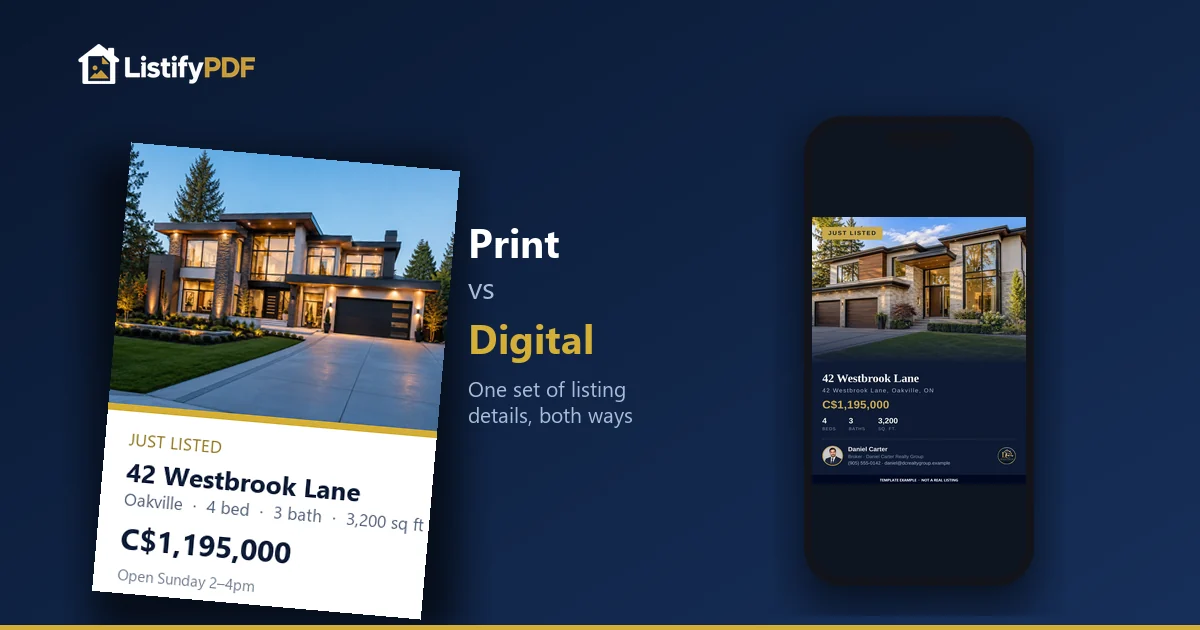
Are printed real estate flyers still relevant?
A buyer viewing four properties on a Saturday cannot, by Sunday evening, reliably say which one had the finished basement, which had the larger garden and which kitchen had been redone. That is the problem a flyer solves, and no amount of online listing solves it, because nobody reopens four browser tabs from memory.
So the printed flyer has not become useless. Its job has narrowed. It is no longer how a property is advertised — portals, social and the MLS do that — it is what the people who already walked through the door carry away. That distinction decides everything else in this article, including how many to print.
What do sellers actually use to market a home?
The National Association of REALTORS® surveys this every year. Its 2024 Profile of Home Buyers and Sellers reported that sellers' agents put homes on the MLS first and foremost (86%) and used yard signs (61%). Printed direct mail sits far below both. The 2025 edition reported that for-sale-by-owner sales fell to a historic low of 5% of sellers, and that 60% of those FSBO sellers already knew their buyer.
Two cautions about reading any of this as advice. First, those figures describe how often a method was used, not how much it contributed to a sale. Second, and more relevant here, surveys of this kind measure direct mail and postcards — advertising sent to strangers — and not the brochure handed to someone standing in the hallway. The leave-behind is not in the data either way, which is a reason to judge it on whether visitors take it rather than on a statistic.
The figures above are from US surveys. Marketing practice and advertising rules differ in Canada and elsewhere.
Print versus digital: what each is actually for
| Printed flyer | Digital listing and posts | |
|---|---|---|
| Job | Remembering a property after seeing it | Finding and researching it |
| Reaches | People already at the door | Anyone, including out of town |
| Changing the price | Reprint | Edit once |
| Sharing | Hand it over | A link, in seconds |
| Measuring it | Count what was taken | Views, clicks, enquiries |
Print earns its place when there is an open house or a showing, when a buyer is seeing several properties in a day, when the property has features that need explaining, or when the price point makes a cheap handout look wrong. Digital earns it everywhere else, and it is the only one of the two that reaches a buyer who has not yet heard of the property.
Neither decides a sale. Price, condition, location and exposure do.
What about selling without an agent?
FSBO sellers carry the whole marketing job themselves, and the figures above suggest where the effort actually goes: with 60% of FSBO sales made to someone the seller already knew, volume marketing is rarely the constraint. Getting the property seen by strangers at all is.
A workable minimum for a private sale is one good brochure used three ways — a PDF to email to enquiries, a handful printed for showings, and the same details as a social post for local groups and Marketplace. One set of details, three outputs, nothing retyped.
What should an open house flyer include?
A flyer is read in about ten seconds on the way to the car, so it carries six things:
- One strong photograph. Usually the exterior; for a condo, the living room or the view.
- The address and the asking price, large enough to read at arm's length.
- Bedrooms, bathrooms, square footage — the three numbers every buyer compares.
- Two or three features that distinguish it, not a list of every room.
- Your contact details, and your brokerage identification if your jurisdiction requires it.
- A QR code to the full listing, which is what keeps the page from having to hold everything.
On paper size: US Letter in North America, A4 nearly everywhere else — the brochure sizes and formats guide covers the choice between a flyer, a trifold and a booklet, and the photo resolution each one needs to print sharp.
Should you put a QR code on a flyer?
Yes, with one condition: it has to lead somewhere worth arriving at. A QR code pointing at a homepage wastes the scan. Point it at the listing itself, a photo gallery, a virtual tour or a booking page, make sure that page is readable on a phone, and scan it yourself off the printed copy before the open house — not off the screen, off the paper, because that is where a low-contrast or undersized code fails.
How many flyers should you print?
Ten to twenty for a normal open house. That is enough for the people who genuinely want one, cheap enough that nobody minds the leftovers, and small enough to reprint after a price change without wincing. Scale up only once you have counted what gets taken at an event, and offer the QR code alongside for visitors who would rather have it on their phone.
Count the leftovers afterwards. Two weekends of that tells you more about whether print works for your market than any survey can.
Common mistakes
- Too much text. A flyer is scanned, not read. Paragraphs lose.
- Weak photographs. A dark or distorted hero image undermines everything printed under it.
- A stale price. If the price moves, the printed copies and the social posts both have to move with it.
- No contact route. Interested buyers should not have to search for you.
- Details that disagree. A flyer saying 3,200 sq ft beside a post saying 3,000 costs you more credibility than either document earns.
- Ignoring advertising rules. Brokerage identification, disclosure and privacy requirements vary by jurisdiction. Check yours before distributing.
A practical plan for 2026
Prepare the listing page and photographs first, then make the brochure and the matching posts from the same details, then print a small batch. Share the open house a few days ahead on the channels you are permitted to use, make the information easy to take away on the day, and follow up afterwards. The open house marketing checklist sets out that sequence day by day, and the social post sizes guide covers what the online half should look like.
Frequently asked questions
- Do real estate agents still use printed flyers in 2026?
- Yes, but as a leave-behind rather than as advertising. A flyer is what a visitor carries out of an open house and looks at that evening; it is not how anyone finds the property in the first place. That part is the listing portals and social.
- Are open house flyers worth the printing cost?
- At ten or twenty copies, almost always — the cost is a few dollars and the alternative is a visitor who cannot remember which house had the finished basement. At two hundred copies for a weekend open house, rarely. Print a small batch, count what is taken, and let that decide the next one.
- What is the best size for a real estate flyer?
- US Letter (8.5 × 11 in) in North America, A4 (210 × 297 mm) almost everywhere else. The formats, and which suits a flyer against a trifold or a booklet, are covered in the brochure sizes guide.
- What should be included in a real estate brochure?
- The address, the asking price, bedrooms, bathrooms, square footage, two or three features that distinguish the property, your contact details, and a QR code to the full listing. Everything else is optional.
- Is digital marketing better than printed brochures?
- They do different jobs. Digital is how a property is discovered, shared and updated; print is what a person holds during and after a visit. The useful question is not which to choose but whether both carry the same price and the same details.
- Can FSBO sellers create professional property brochures?
- Yes. A template-based tool produces the same print-ready document a designer would, and the harder parts of selling without an agent are pricing, exposure and paperwork rather than the brochure. Check your local advertising and disclosure rules before distributing anything.
Making the brochure and the matching posts
If you prepare listing material regularly, the repetitive part is not the design — it is typing the same address, price and figures into a brochure, then again into every social post. ListifyPDF takes the details once and produces both: 53 print-ready brochure templates, reusable agent branding, and QR codes.
Every new account starts with 30 days of full Pro — unlimited brochures, AI-assisted descriptions and matching social posts — with no credit card. After that the free plan continues with three brochures a month, all 53 templates, no watermark and your own branding; Pro adds unlimited brochures, 30 AI descriptions and 100 social posts a month.
Final thoughts
Printed flyers are not outdated and they are not the main event. A buyer finds a property on a screen and remembers it on paper, and the only real failure is letting the two disagree about the price. Print a few, point them at the listing, and put the effort where the property is actually being discovered.