What to Include in a Real Estate Brochure: Complete Agent Checklist
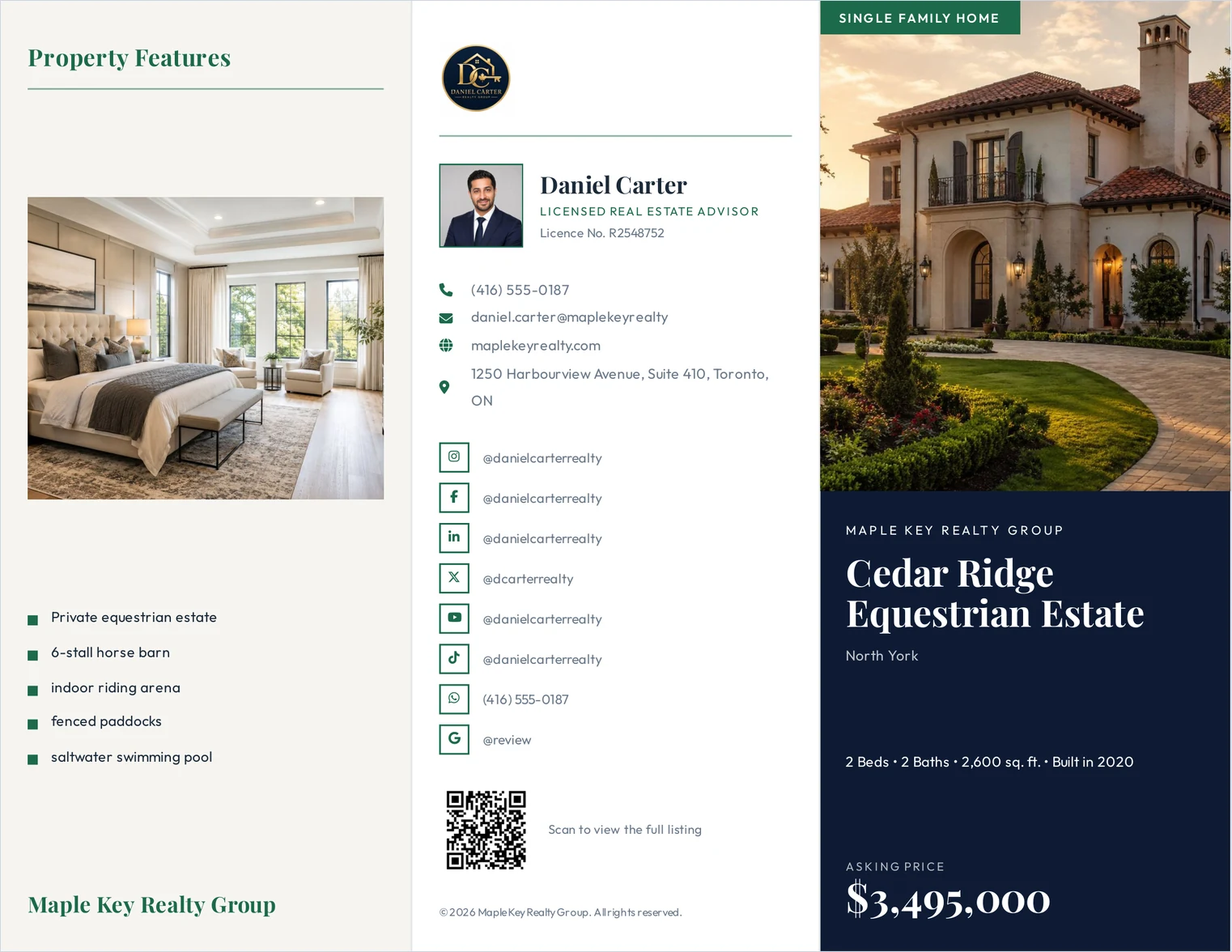
A real estate brochure needs the price, address, bed and bath counts, floor area, lot size, year built, eight to twelve photographs, a short specific description, a feature list, neighbourhood notes, your contact details and your licence number where your jurisdiction requires it. Everything else is optional, and most of it is better left off.
- What should a real estate brochure include?
- The essentials
- How many photographs, and in what order?
- What makes a property description work?
- What should the feature list contain?
- Should you include neighbourhood information?
- What do agents most often leave off?
- What should you leave off?
- The checklist
- Common questions
What should a real estate brochure include?
What to include in a real estate brochure comes down to about a dozen items: everything a buyer needs to decide whether to view the property, and nothing that makes that decision harder. In practice that is about a dozen items, and the discipline is in what you leave out.
The essentials
If one of these is missing, a buyer either has to ask you or moves on. Assume they move on.
| Item | Why it has to be there |
|---|---|
| Asking price | A brochure without a price reads as evasive. If the price is unusual, explain it in a line rather than hiding it. |
| Address or location | Full address for a standard listing; neighbourhood and nearest cross-street where privacy matters. |
| Bedrooms and bathrooms | The counts a buyer checks before anything else on the page. |
| Floor area | With the unit stated. Square feet and square metres are not interchangeable to a buyer scanning quickly. |
| Lot size | Frequently left blank, and frequently asked about afterwards. |
| Year built | Informs what a buyer assumes about wiring, windows, roof and insulation. |
| Photographs | Eight to twelve, ordered as a walkthrough rather than by room type. |
| Description | 80 to 140 words, leading with the specific. |
| Feature list | Scannable. Six to ten items, concrete ones. |
| Your contact details | Name, title, brokerage, phone, email — and licence number where required. |
| Call to action | One, specific: book a viewing, scan for the full listing, call for the floor plan. |
How many photographs, and in what order?
For many residential listings, eight to twelve works; a large property or a booklet can carry sixteen. The order matters more than the count.
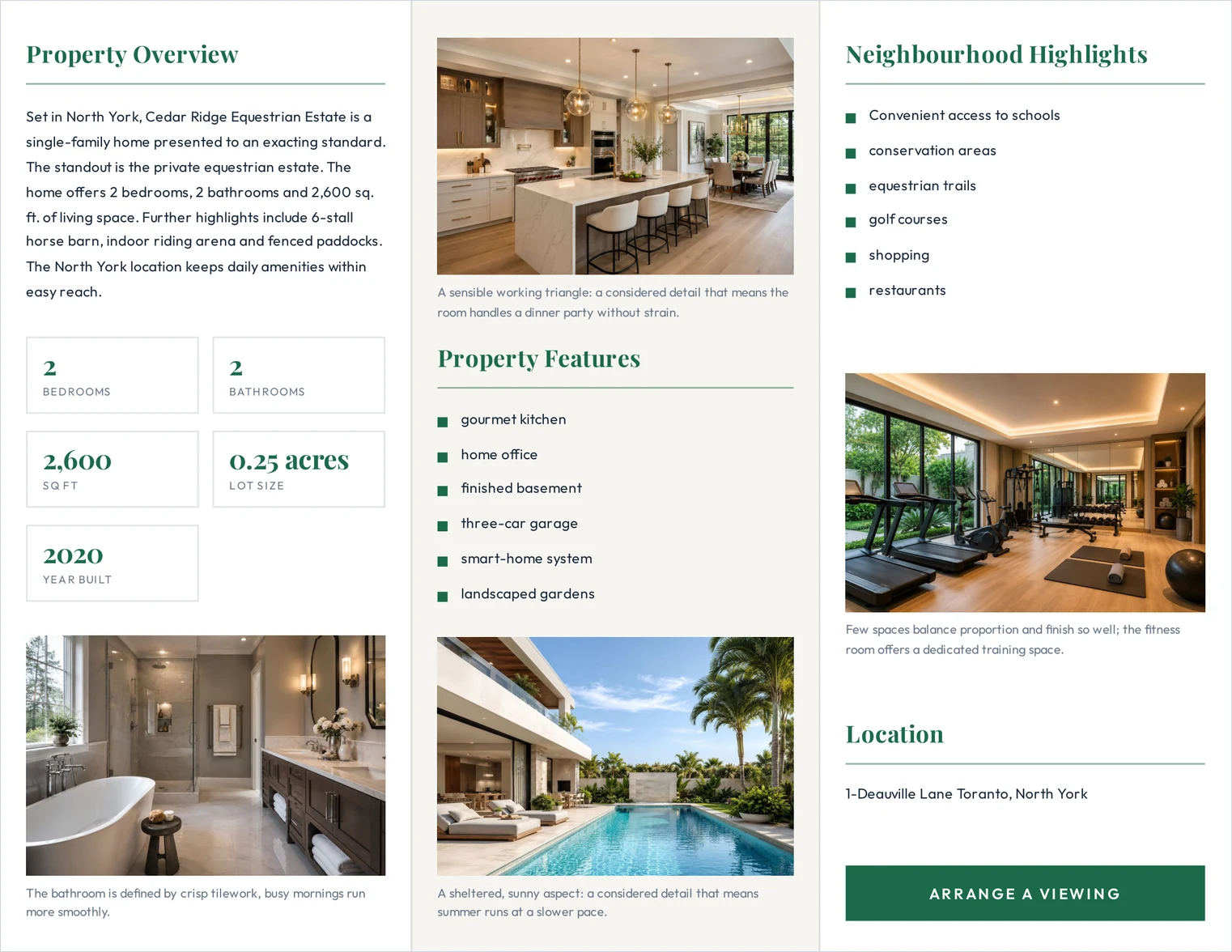
Lead with the exterior unless the outside is the weak point, then the main living space, kitchen, primary bedroom, primary bathroom, outdoor space, and anything genuinely unusual. Secondary bedrooms last, or not at all.
One practical note on the cover photograph. It prints larger than anything else on the page, so it needs the most pixels: a full-width photograph on an A4 sheet needs about 2,500 pixels across to reach the 300 DPI print shops ask for. Any recent phone produces roughly 4,000, so the original is fine. The risk is using a copy that has been through a messaging app, since those compress photographs and can reduce them well below what print needs.
What makes a property description work?
Specificity, and brevity. The description is competing with the photographs, and it should lose.
A structure that holds up: one sentence placing the property, one on what is unusual about it, two or three on the rooms that matter, one on the location. Then stop — on a brochure the photographs are doing most of the work.
Replace anything that could be said about any house. "Spacious and bright" describes nothing. "A south-facing kitchen with doors onto the terrace" describes one house. If a phrase would survive being copied onto a different listing, it is not earning its place.
What should the feature list contain?
Concrete, checkable things — the items a buyer would otherwise have to ask about. Six to ten is plenty.
- Good: gas range, finished basement, two-car garage, heated floors, 2019 roof, fenced garden, home office
- Weak: stunning finishes, must be seen, great location, immaculate throughout
The weak ones are not false, they are simply unfalsifiable — they describe no particular house, so they do nothing to distinguish this one.
Should you include neighbourhood information?
Yes, briefly, and factually. Schools, transport, shops, parks — the things that decide whether a buyer can live there, not adjectives about lifestyle.
Keep it to a short list. A paragraph praising the area reads as padding; four specifics read as useful.
What do agents most often leave off?
Four fields go missing more often than the rest. None of them is difficult to supply; they are simply easy to forget.
- Lot size. Omitted constantly, wanted frequently.
- A licence number, where the jurisdiction requires it on advertising. Rules differ by board and by country, so check yours rather than copying another agent's brochure.
- A way back to the full listing. A printed sheet is a dead end without a QR code or a short link.
- The date, or deliberately no date. A brochure that outlives the listing by six months is worse than no brochure. Either date it or make it clear it is not a contract.
What should you leave off?
Deciding what to include in a real estate brochure is partly deciding what to leave out, and that is most of the skill. A brochure is not a property report.
- Every room photographed. Twenty photographs on one sheet means twenty small photographs.
- Floor plans, usually. They rarely survive being shrunk to fit. Put them behind the QR code.
- Long legal text. One short disclaimer line is enough; the detail belongs in the contract.
- Several calls to action. Pick one. Three choices is no choice.
- Your brokerage's full history. The buyer is choosing a house.
The checklist
Print this, or work down it before you send a brochure anywhere.
- Asking price, stated plainly
- Address or location, at the precision the seller agreed to
- Bedrooms, bathrooms
- Floor area, with the unit
- Lot size
- Year built
- Eight to twelve photographs, ordered as a walkthrough
- Cover photograph at least 2,500 pixels wide, from the original file
- Description of 80–140 words, leading with the specific
- Six to ten concrete features
- Three or four neighbourhood facts
- Your name, title, brokerage, phone, email
- Licence number, if your jurisdiction requires it
- One call to action
- QR code to the full listing
- A short disclaimer line
- Text in the PDF is selectable — if it is not, the fonts were not embedded
Common questions
- What is the most important thing on a real estate brochure?
- The cover photograph and the price. The photograph is what a reader sees first, and the price is what they look for next — so those two carry most of the weight on the page.
- Should the price go on the brochure?
- Yes, in almost every case. A brochure without one leaves the reader to ask, and many will not. Where the seller does not want a figure published, say what the arrangement is rather than leaving a gap.
- How long should a property description be?
- 80 to 140 words on a brochure. Longer belongs on the listing page, where a reader has chosen to read rather than glance.
- Do I have to put my licence number on a brochure?
- In many jurisdictions, yes — advertising rules commonly require it. The requirements differ by board and country, so check the rules that apply to you rather than copying what another agent has done.
- Should I include a floor plan?
- Usually not on the brochure itself: shrunk to fit alongside everything else it becomes unreadable. Put it behind the QR code, or supply it as a separate sheet on request.
- How do I know the brochure will print well?
- Two checks. Confirm the cover photograph is around 2,500 pixels wide, and try to select the text in the PDF — if you cannot, the type was drawn as outlines rather than embedded, and it will look soft. The step-by-step guide covers both in more detail.